
Recently, the martial arts world marked the passing of Chuck Norris—a figure whose name has become synonymous with strength, discipline, and longevity in practice. For many, he is a cultural icon. For others, he is a martial artist whose influence helped shape generations.
For me, his passing brought something more personal to the surface.
It brought me back to lineage.
A Lineage Rooted in Tradition
Before the fame, before the films, Chuck Norris was a student—trained by Jae Chul Shin, a Korean Karate Master and founder of the World Tang Soo Do Association. Grandmaster Shin’s school was located in the same neighborhood where I grew up as a teenager. That proximity mattered. It meant that what can often feel distant in martial arts—the idea of lineage, of connection—was, for me, something real and tangible.
I trained in that system. I competed under that banner.
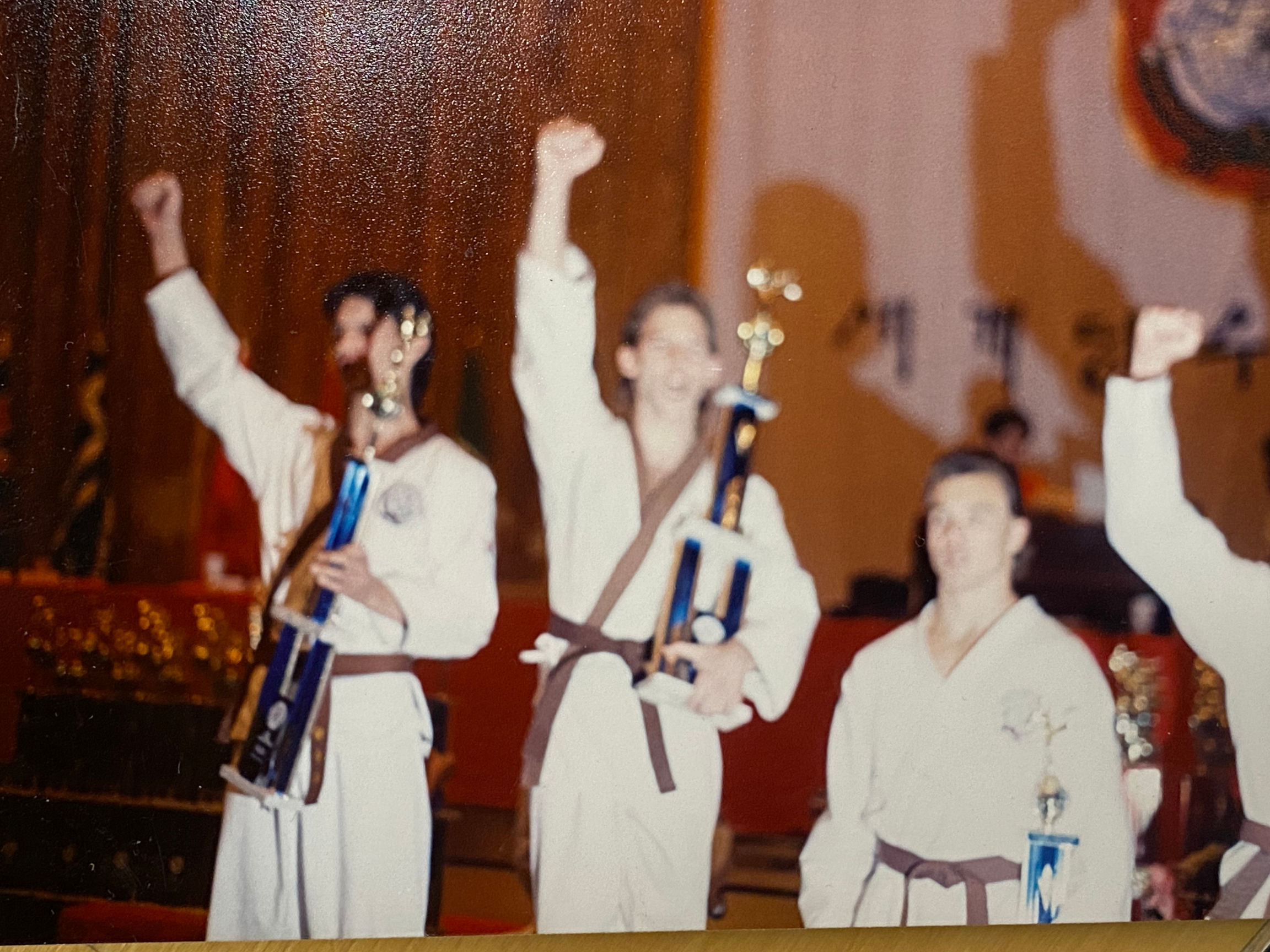
In 1988, 1990, and 1992, I competed in the World Tang Soo Do Championships. In 1988, as an adult brown belt, I won the world title in both fighting and forms in my division. In 1990, I lost. In 1992, I returned as a black belt candidate (Chodan Bo) and earned third place in both fighting and forms.
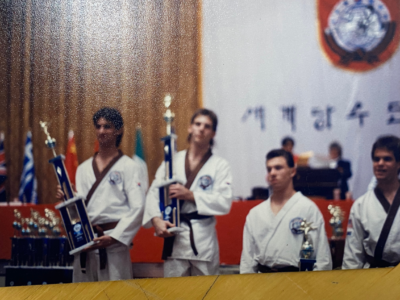
Dr. Salvatore Sandone celebrates winning the 1988 World Tang Soo Do Championships as an adult brown belt, holding a trophy alongside fellow competitors.
Those experiences shaped me—not just the victories, but the losses as well.
And like many martial artists, my development was not just my own. It was shaped by the teachers and mentors who came before me. I share part of my martial arts lineage and early success with the same tradition that influenced Chuck Norris—through Grandmaster Shin and instructors such as Masters Godwin and Marvel, both world champions in their own right.
This is how martial arts works.
Lineage is not an abstract idea. It is lived through instruction, through correction, through repetition. It is passed down in small moments—how to stand, how to move, how to think.
At one point, a classmate of mine was recruited to work with Chuck Norris’ nonprofit organization, Kick Drugs Out of America, later known as Project Kickstart. That organization continues to serve children in Texas, using martial arts as a vehicle for discipline, confidence, and positive development.
That mission resonated with me.
Building Zhang Sah
In 1998, I founded Gold Medal Karate. In 2003, that work took a significant turn. My school merged with my teacher, Grand Master Soon Ho Chang’s school, Chang’s School of Judo and Karate. From that union, Zhang Sah was born.
It was a moment that reflected the very essence of martial arts lineage—schools, ideas, and people coming together to build something greater than any one individual.
When the Path Becomes Uncertain
But lineage is not always simple.
In 2009, as a fourth-degree master, I was expelled from Chang’s School due to internal disagreements and competing interests. Grand Master Chang eventually retired. It was a difficult chapter—one that reminded me that even within traditions built on discipline and respect, human complexities still exist.
And yet, the practice continued.
I continued.
I have made every effort to remain an exemplar of our tenets, to lead within my community, and to carry forward the values instilled through years of training. The circumstances changed, but the commitment did not.
Our black belt credo is “Paek Jul Bul Kul”—a Korean maxim meaning, “Even if I am broken into one hundred pieces, I will not surrender.”
That idea is not about defiance for its own sake. It is about commitment. It is about remaining true to one’s path, even when that path becomes uncertain or difficult.
For me, that credo became real.
Perhaps that, too, is part of legacy.
The Fragility of Schools
Grandmaster Shin’s school eventually closed some years after his passing.
Today, that space is no longer a dojo. It is a neighborhood bodega.
I find that deeply saddening.
Not because change is inherently bad—but because something meaningful was lost in the process. Martial arts schools are more than places to train. They are repositories of knowledge, discipline, culture, and community.
In many ways, I view martial arts teachers as living libraries.
They carry knowledge that cannot be easily replaced. Years—sometimes decades—of study, experience, and refinement live within them. When a school closes, especially one tied to a lineage, it is not just a business that disappears. It is a body of knowledge, a community, and a living tradition that risks being forgotten.
That loss is difficult to measure, but it is real.
And it raises an important question:
What happens to a lifetime of devotion when the individual is no longer there to carry it forward?
As a martial artist, a teacher, and the founder of a nonprofit organization, I think about this often. Legacy is not guaranteed. Even the most meaningful work can fade if it is not sustained, supported, and passed on.
It is a fragile thing.
Legacy Requires Intention
The passing of Chuck Norris reminds us of his contributions. The work of his organization continues. The influence of his teachers lives on through those who trained under them. But we are also reminded that continuation is not automatic.
It requires intention.
It requires community.
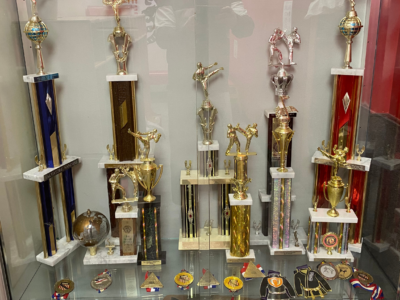
A display case at Zhang Sah martial arts school in Philadelphia showcasing karate trophies and medals earned across decades of competition, including World Tang Soo Do Championship titles.
It requires people who are willing to carry something forward—not just in name, but in practice.
At Zhang Sah, this is something we take seriously. Our martial arts classes and programs are not just about physical training. It is about cultivating habits, values, and ways of thinking that endure over time. It is about building something that can be passed on—not just to the next class, but to the next generation.
That kind of work does not happen by accident.
It happens through consistency. Through teaching. Through showing up, day after day, year after year.
It also requires recognition that what we build is bigger than any one individual.
Perhaps that is the lesson in all of this.
We begin as students. We grow as practitioners. Some of us become teachers. A few go on to build organizations. But ultimately, what matters is not just what we achieve—it is what we leave behind, and whether it continues to live.
I hope that the work of Project Kickstart continues to thrive in Texas. I hope that the lessons passed down from Grandmaster Shin continue to reach new students. And I hope that in our own way, we — and the legacy of this work here in Philadelphia — contribute to something that endures.
Because in the end, martial arts is not just about strength or skill.
It is about continuity.
It is about carrying something forward with care.
And it is about ensuring that the “libraries” we build—through teaching, through community, through shared practice—do not disappear quietly, but continue to serve long after we are gone.
Dr. Salvatore Sandone is the founder and CEO of Zhang Sah, a Philadelphia-based nonprofit martial arts organization offering karate and adult martial arts programs for children, adults, and families. To learn more or to enroll, visit zhangsah.org.